
AFP Asia Business

UN says record 383 aid workers killed in 2024

A record 383 aid workers were killed in 2024, the United Nations said Tuesday, branding the figures and lack of accountability a “shameful indictment” of international apathy — and warned this year’s toll was equally disturbing.The 2024 figure was up 31 percent on the year before, the UN said on World Humanitarian Day, “driven by the relentless conflicts in Gaza, where 181 humanitarian workers were killed, and in Sudan, where 60 lost their lives”.It said state actors were the most common perpetrators of the killings in 2024.The UN said most of those killed were local staff, and were either attacked in the line of duty or in their homes.Besides those killed, 308 aid workers were wounded, 125 kidnapped and 45 detained last year.”Even one attack against a humanitarian colleague is an attack on all of us and on the people we serve,” said UN aid chief Tom Fletcher.”Attacks on this scale, with zero accountability, are a shameful indictment of international inaction and apathy. “As the humanitarian community, we demand — again — that those with power and influence act for humanity, protect civilians and aid workers and hold perpetrators to account.”Provisional figures from the Aid Worker Security Database show that 265 aid workers have been killed this year, as of August 14.The UN reiterated that attacks on aid workers and operations violate international humanitarian law and damage the lifelines sustaining millions of people trapped in war and disaster zones.”Violence against aid workers is not inevitable. It must end,” said Fletcher, the UN emergency relief coordinator and under-secretary-general for humanitarian affairs.Meanwhile the UN’s World Health Organization said it had verified more than 800 attacks on health care in 16 territories so far this year, with more than 1,110 health workers and patients killed and hundreds injured.”Each attack inflicts lasting harm, deprives entire communities of life-saving care when they need it the most, endangers health care providers, and weakens already strained health systems,” the WHO said.World Humanitarian Day marks the day in 2003 when UN rights chief Sergio Vieira de Mello and 21 other humanitarians were killed in the bombing of the UN headquarters in Baghdad.

UN debates future withdrawal of Lebanon peacekeeping force

The United Nations Security Council began to debate Monday a resolution drafted by France to extend the UN peacekeeping force in south Lebanon for a year with the ultimate aim to withdraw it.Israel and the United States have reportedly opposed the renewal of the force’s mandate, and it was unclear if the draft text has backing from Washington, which wields a veto on the Council.A US State Department spokesman said “we don’t comment on ongoing UN Security Council negotiations,” as talks continued on the fate of the UN Interim Forces in Lebanon (UNIFIL), deployed since 1978 to separate Lebanon and Israel.The text, first reported by Reuters, would “extend the mandate of UNIFIL until August 31, 2026” but “indicates its intention to work on a withdrawal of UNIFIL.”That would be on the condition that Lebanon’s government was the “sole provider of security in southern Lebanon… and that the parties agree on a comprehensive political arrangement.”Under a truce that ended a recent war between Israel and Iran-backed Hezbollah, Beirut’s army has been deploying in south Lebanon and dismantling the militant group’s infrastructure there.Lebanon has been grappling with the thorny issue of disarming Hezbollah, with the cabinet this month tasking the army with developing a plan to do so by the end of the year. The Iran-backed group has pushed back.Under the truce, Israel was meant to completely withdraw from Lebanon, though it has kept forces in several areas it deems strategic and continues to administer strikes across Lebanon. Israel’s forces have also had tense encounters with the UN blue helmets.The draft resolution under discussion also “calls for enhanced diplomatic efforts to resolve any dispute or reservation pertaining to the international border between Lebanon and Israel.”Council members were debating the draft resolution seen by AFP Monday ahead of a vote of the 15-member council on August 25 before the expiration of the force’s mandate at the end of the month.

Hamas accepts new Gaza truce plan: Hamas official

Hamas has accepted a new ceasefire proposal for Gaza, a senior member from the group said Monday, after a fresh diplomatic push to end more than 22 months of war.Mediators Egypt and Qatar, backed by the United States, have struggled to secure a lasting truce in the conflict, which has triggered a dire humanitarian crisis in the Gaza Strip.But after receiving a new proposal from mediators, Hamas said it was ready for talks.”The movement has submitted its response, agreeing to the mediators’ new proposal. We pray to God to extinguish the fire of this war on our people,” senior Hamas official Bassem Naim said on Facebook.Earlier a Hamas source told AFP the group accepted the proposal “without requesting any amendments”.Egypt said it and Qatar had sent the new proposal to Israel, adding “the ball is now in its court”. Israel has yet to respond.A Palestinian source familiar with the talks said mediators were “expected to announce that an agreement has been reached and set a date for the resumption of talks”, adding guarantees were offered to ensure implementation and pursue a permanent solution.According to a report in Egyptian state-linked outlet Al-Qahera, the deal proposed an initial 60-day truce, a partial hostage release, the release of some Palestinian prisoners and provisions to allow for the entry of aid.The proposal comes more than a week after Israel’s security cabinet approved plans to conquer Gaza City and nearby refugee camps, which has sparked international outcry as well as domestic opposition.- ‘Confronted and destroyed’ -Out of 251 hostages taken during Hamas’s October 2023 attack that triggered the war, 49 are still held in Gaza including 27 the Israeli military says are dead.Earlier, an Islamic Jihad source said “the remaining captives would be released in a second phase”, with negotiations for a broader settlement to follow.They added that “all factions are supportive” of the Egyptian and Qatari proposal.US President Donald Trump wrote on Truth Social: “We will only see the return of the remaining hostages when Hamas is confronted and destroyed!!!””The sooner this takes place, the better the chances of success will be.”Last week, Prime Minister Benjamin Netanyahu said Israel “will agree to an agreement in which all the hostages are released at once and according to our conditions for ending the war”.Earlier Monday, Netanyahu said he reviewed plans for the upcoming offensive in Gaza while meeting the head of the army and minister of defence and stressed that Hamas was under “extreme pressure”. Egyptian Foreign Minister Badr Abdelatty, visiting the Rafah border crossing with Gaza on Monday, said Qatari Prime Minister Sheikh Mohammed bin Abdulrahman Al Thani was visiting “to consolidate our existing common efforts in order to apply maximum pressure on the two sides to reach a deal as soon as possible”.Alluding to the dire humanitarian conditions for the more than two million people living in the Gaza Strip, where UN agencies and aid groups have warned of famine, Abdelatty stressed the urgency of reaching an agreement.”The current situation on the ground is beyond imagination,” he said.Egypt said on Monday it was willing to join a potential international force deployed to Gaza, but only if backed by a UN Security Council resolution and accompanied by a “political horizon”.- ‘Deliberate’ starvation -On the ground, Gaza’s civil defence agency said Israeli forces killed at least 20 people across the territory on Monday, including six in the south.Contacted by AFP, the Israeli military said it was “not aware of any casualties as a result of IDF fire” in the southern areas reported by the civil defence.Media restrictions in Gaza and difficulties accessing swathes of the Palestinian territory mean AFP is unable to independently verify the tolls and details provided by the civil defence agency or the Israeli military.Eyewitnesses later told AFP that residential areas, including Zeitoun and al Sabra neighbourhoods, in Gaza City were under heavy fire, with tanks and heavy artillery targeting the area. Rights group Amnesty International meanwhile accused Israel of enacting a “deliberate policy” of starvation in Gaza and “systematically destroying the health, well-being and social fabric of Palestinian life”.Israel, while heavily restricting aid allowed into Gaza, has repeatedly rejected claims of deliberate starvation.Hamas’s October 2023 attack on Israel resulted in the deaths of 1,219 people, mostly civilians, according to an AFP tally based on official figures.Israel’s offensive has killed more than 62,004 Palestinians, most of them civilians, according to figures from the health ministry in Hamas-run Gaza which the United Nations considers reliable.

Israeli controls choke Gaza relief at Egypt border, say aid workers

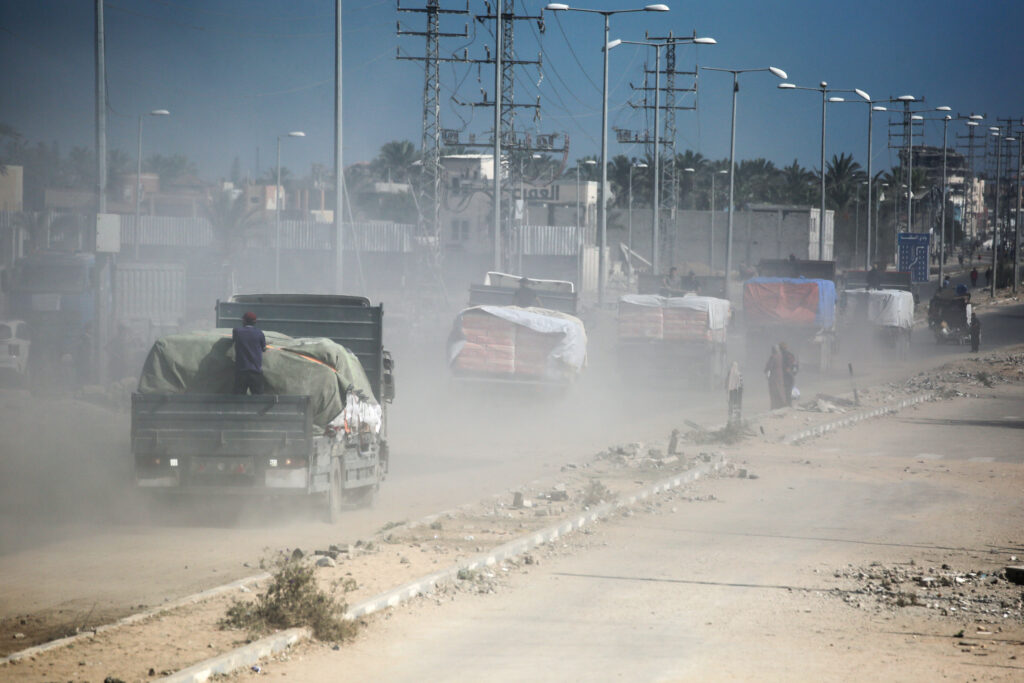
At the Rafah crossing into the Gaza Strip, hundreds of aid trucks sat unmoving in the Egyptian desert, stuck for days with only a handful allowed through by Israel to relieve the humanitarian disaster across the border.After nearly two years of war, UN-backed experts have said famine is unfolding in the Palestinian territory, while there are also dire shortages of clean water and medicines.Yet aid groups say the flow of essential supplies remains painfully slow, despite the growing crisis.Israel continues to deny entry for life-saving medical equipment, shelters and parts for water infrastructure, four UN officials, several truck drivers and an Egyptian Red Crescent volunteer told AFP.They said the supplies were often rejected for being “dual-use”, meaning they could be put to military use, or for minor packaging flaws.Some materials “just because they are metallic are not allowed to enter,” said Amande Bazerolle, head of emergency response in Gaza at French medical charity MSF.Sitting on the Egyptian side was a truckload of intensive care gurneys baking in the sun, held back by the Israelis despite the UN reporting a severe shortage in Gaza, because one pallet was made of plastic instead of wood, aid workers said.Other shipments were turned away because “a single pallet is askew, or the cling film isn’t wrapped satisfactorily”, said an Egyptian Red Crescent volunteer.Even with everything lined up and approved beforehand, shipments can still be turned back, said Amal Emam, chief of the Egyptian Red Crescent.”You can have a UN approval number stuck to the side of a pallet, which means it should cross, it’s been approved by all sides, including COGAT, but then it gets to the border and it’s turned back, just like that.”COGAT is the Israeli ministry of defence agency that oversees civil affairs in the Palestinian territories.Complying with the restrictions was also incredibly costly, Emam said.”I have never in my life as a humanitarian seen these kinds of obstacles being put to every bit of aid, down to the last inch of gauze,” she added.- ‘Engineered hunger’ -Simple medicines such as ibuprofen can take a week to cross into Gaza.Meanwhile, the World Health Organisation often has to rush to get insulin and other temperature-sensitive medicines through in regular trucks when Israeli officials reject the use of refrigerated containers.In a tent warehouse, dozens of oxygen tanks sat abandoned on Monday, gathering dust months after they were rejected, alongside wheelchairs, portable toilets and generators.”It’s like they’re rejecting anything that can give some semblance of humanity,” a UN staffer told AFP, requesting anonymity because they were not authorised to speak to the press.Olga Cherevko, spokesperson for the UN’s humanitarian agency OCHA, said the prohibited list “is pages and pages of things”.Truck drivers have reported spending days stuck watching other vehicles that are often carrying identical supplies either waved through or rejected without explanation.Egyptian driver Mahmoud El-Sheikh said he had been waiting for 13 days in scorching heat with a truck full of flour. “Yesterday, 300 trucks were sent back. Only 35 were allowed in,” he said. “It’s all at their discretion.”Another driver, Hussein Gomaa, said up to 150 trucks lined up each night on the Egyptian side, but in the morning “the Israelis only inspect however many they want and send the rest of us back”.AFP could not independently verify the daily aid volume entering Gaza from Egypt.A WHO official said that at most 50 trucks enter Gaza every day while Egyptian Foreign Minister Badr Abdelatty said only 130-150 trucks cross daily, sometimes 200 — about a third of what is needed.”This is engineered hunger,” Abdelatty said on Monday, adding that over 5,000 trucks were waiting at the border.- ‘Losing limbs’ -Last week, COGAT denied blocking aid.In a post on X, it said Israel facilitates humanitarian aid while accusing Hamas of exploiting aid to “strengthen its military capabilities” and said 380 trucks entered Gaza last Wednesday.MSF warned aid bottlenecks were costing lives.It cannot bring in vital medical supplies as basic as scalpels or external fixators used to treat broken limbs.”People are at risk of losing limbs because we don’t have basic tools,” Bazerolle said.She added supplies were depleting faster than expected. “We order for three or five months and then in two months it’s gone.”