
AFP Asia Business
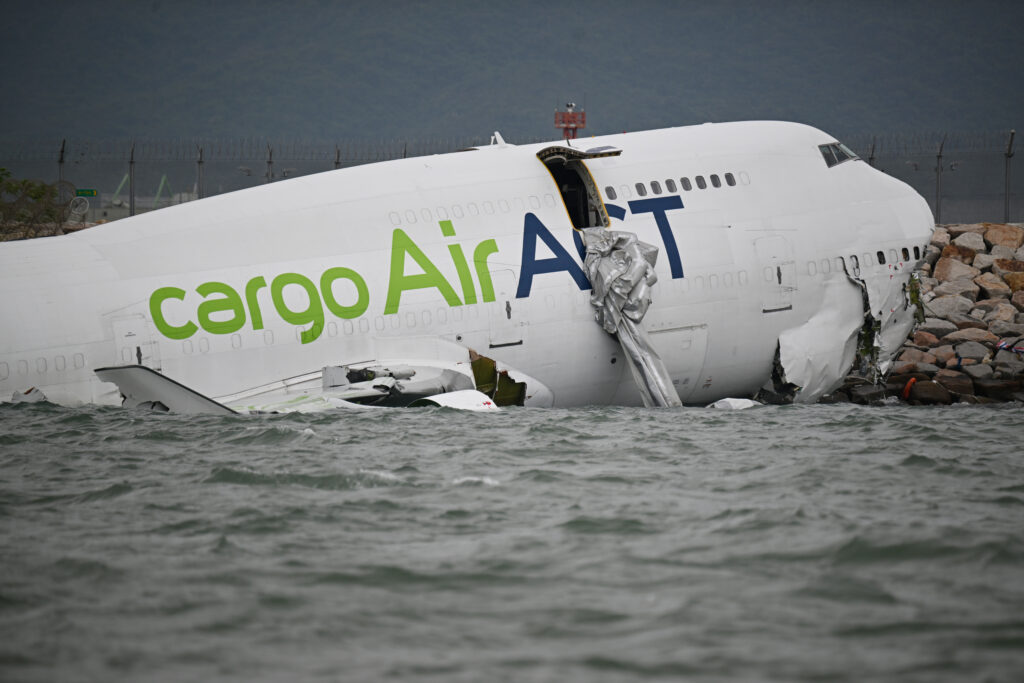
Cargo plane skids off Hong Kong runway, kills two
A cargo plane veered off a runway Monday during landing in Hong Kong, hit a security patrol car and then skidded into the sea, leaving two men in the vehicle dead, authorities said.Officials said an investigation would aim to determine what caused the Boeing aircraft to leave the tarmac at Hong Kong International Airport, one of the busiest in the world for air cargo.The plane’s damaged fuselage was left partly submerged in the sea water that borders the airport, with its emergency evacuation slide extended following one of the most serious incidents since the hub began operations in 1998.Steven Yiu, executive director of airport operations at Airport Authority Hong Kong, said the cargo plane from Dubai “went off from the north runway upon landing and crashed through the fence and into the sea” at around 4 am (2000 GMT Sunday).Yiu said the patrol car was not on the runway at the time of the accident, and that “it was the aircraft that veered off the runway to hit the patrol car, which was outside the fence” and pushed it into the water.A 30-year-old man aboard the ground vehicle was confirmed dead at the scene while another, aged 41, died after being rushed to hospital.Both men were retrieved from the sunken car by divers around five metres (16 feet) from the shore.Emirates airlines said the plane’s crew were confirmed to be safe and there was no cargo onboard.Emirates added the involved plane was on a temporary short-term, or “wet”, lease from Act Airlines, which operated the aircraft.- Abrupt turn -Yiu said that “weather and runway conditions were safe and meet all conditions for runway operation” at the moment of the incident.Officials provided a diagram that showed the plane abruptly turning left halfway down the length of the runway.The aircraft did not send an emergency signal and gave no reply when radioed by the airport, officials added.The airport’s north runway was temporarily closed on Monday, while the other two runways remained operational.The incident was not expected to impact airport operations, Yiu said.A spokesman for the Transport and Logistics Bureau expressed deep concern over the incident, adding that the Air Accident Investigation Authority will “actively investigate the cause of the accident”.Police said they will not rule out launching a criminal investigation.Helicopters from the Government Flying Service and vessels from the Fire Services Department have been deployed, according to media reports.Hong Kong began flight operations on its third runway last November, with the city’s airport being among the busiest in the world.The expansion project cost HK$142 billion ($18 billion) and took eight years of construction, with officials saying it would keep the city’s airport competitive as an aviation hub.
Trump says Gaza ceasefire still in force after Israeli strikes
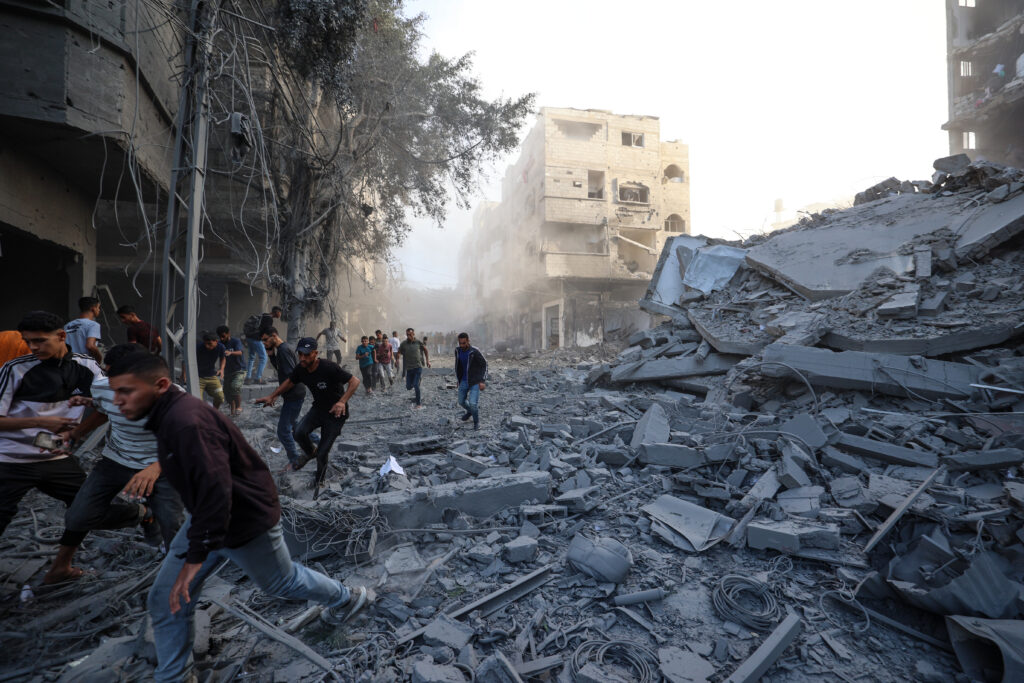
US President Donald Trump said Sunday that a ceasefire in Gaza was still holding after Israel carried out deadly strikes on the territory over alleged truce violations by Hamas.The dozens of strikes Israel carried out on Hamas positions in southern Gaza Sunday came after it accused the militant group of targeting its troops in “a blatant violation” of the nine-day-old truce.Asked by reporters whether the truce was still in effect, Trump said: “Yeah, it is”. The US president, who helped broker the deal, also suggested that Hamas leadership was not involved in any alleged breaches, instead blaming “some rebels within”.”We want to make sure that it’s going to be very peaceful with Hamas,” Trump said. “It’s going to be handled toughly, but properly.”Gaza’s civil defence agency, which operates under Hamas authority, said the strikes killed at least 45 people across the territory.Four hospitals in Gaza confirmed the death toll of 45 to AFP, saying they had received the dead and wounded.Israel’s military said it was looking into the reports of casualties.Media restrictions in Gaza and difficulties in accessing many areas mean AFP is unable to independently verify the tolls and details provided by the civil defence agency or the Israeli military.The army said it had “renewed enforcement of the ceasefire” on Sunday but vowed to “respond firmly to any violation of it”.Hamas denied the accusations, one official accusing Israel of fabricating “pretexts” to resume the war.A security official also told AFP that Israel was suspending the entry of aid into Gaza due to ceasefire violations.Israel repeatedly cut off aid to Gaza during the war, exacerbating dire humanitarian conditions, with the United Nations saying it caused a famine there.- ‘Blood has returned’ -The ceasefire, which began on October 10, halted more than two years of devastating war between Israel and Hamas.The deal established the outline for hostage and prisoner exchanges, and proposed an ambitious roadmap for Gaza’s future. But it has quickly faced challenges to its implementation. Israel said on Sunday that two of its soldiers died in clashes in the city of Rafah. “Earlier today, terrorists fired anti-tank missiles and opened fire on IDF (Israeli army) forces,” in Rafah, the military said in a statement. “The IDF responded with air strikes by fighter jets and artillery fire, targeting the Rafah area.” Palestinian witnesses told AFP clashes erupted in the southern city in an area still held by Israel.One witness, a 38-year-old man who asked not to be named, said that Hamas had been fighting a local Palestinian gang known as Abu Shabab but the militants were “surprised by the presence of army tanks”.”The air force conducted two strikes from the air,” he added.Abdullah Abu Hasanin, 29, from Al‑Bureij camp in central Gaza where Israel launched strikes, said: “The situation is as if the war has returned anew.”We had hoped the agreement would hold, but the occupation respects nothing — not an agreement, not anything.”He said he had rushed to the site of the bombing to help, adding: “The scene is indescribable. Blood has returned again.”- ‘Security illusion’ -AFP images from Bureij showed Palestinians running for cover from the strikes, as well as the dead and wounded arriving at Deir al-Balah hospital, accompanied by grieving relatives.Defence Minister Israel Katz warned Hamas would “pay a heavy price for every shot and every breach of the ceasefire”, adding Israel’s response would “become increasingly severe”.A statement from Izzat Al-Rishq, a member of Hamas’s political bureau, reaffirmed the group’s commitment to the ceasefire.Israel, it said, “continues to breach the agreement and fabricate flimsy pretexts to justify its crimes”.Hamas’s armed wing insisted on Sunday that it had “no knowledge” of any clashes in Rafah.On Sunday, US Vice President JD Vance called on Gulf Arab countries to establish a “security infrastructure” to ensure that Hamas disarmed — a key part of the peace deal.Under Trump’s 20-point plan, Israeli forces have withdrawn beyond the so-called Yellow Line. That leaves them in control of around half of Gaza, including the territory’s borders but not its main cities.- Bodies returned -Hamas in turn has released 20 surviving hostages and is in the process of returning the remaining bodies of those who have died.Israel returned the bodies of 15 Palestinians to Gaza on Sunday, bringing the total number handed over to 150, the health ministry in the Hamas-run territory said.Israel has linked the reopening of the Rafah crossing — the main gateway into Gaza — to the recovery of all of the deceased.Hamas has said it needs time and technical assistance to recover the remaining bodies from under Gaza’s rubble.The war, triggered by Hamas’s October 7, 2023 attack on Israel, has killed at least 68,159 people in Gaza, according to the health ministry in the Hamas-run territory, figures the United Nations considers credible.The data does not distinguish between civilians and combatants but indicates that more than half of the dead are women and children.Hamas’s 2023 attack on Israel resulted in the deaths of 1,221 people, mostly civilians, according to an AFP tally based on official Israeli figures.burs-jj/rlp/ceg/dhw
Trump says Israel-Hamas ceasefire still in place after Gaza strikes
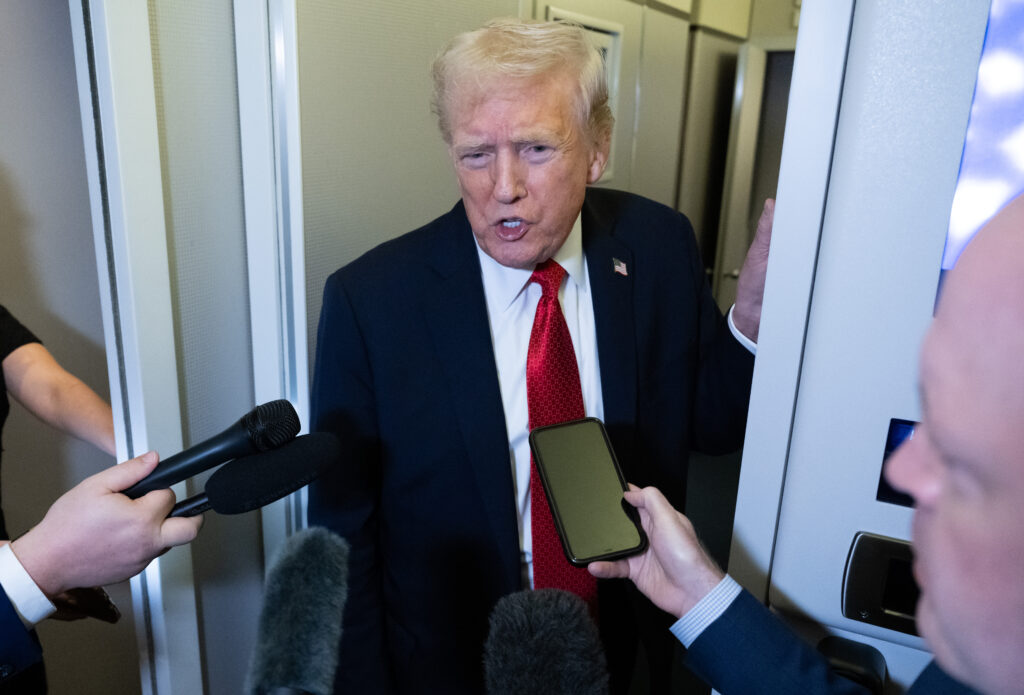
US President Donald Trump said Sunday that the ceasefire between Israel and Hamas was still in effect after the Israeli military carried out deadly strikes on Gaza over apparent truce violations by the Palestinian armed group. “Yeah, it is,” Trump told reporters aboard Air Force One when asked if the ceasefire was still in place. He also suggested that Hamas leadership was not involved in any alleged breaches and instead blamed “some rebels within.””But either way, it’s going to be handled properly. It’s going to be handled toughly, but properly,” Trump added.Israel said it had resumed enforcing the Gaza ceasefire after it struck Hamas positions Sunday, having accused the group of targeting its troops in the most serious violence since the nine-day-old truce began.Gaza’s civil defense agency, which operates under Hamas authority, said at least 45 people had been killed across the territory in Israeli strikes. Israel’s military said it was looking into the reports of casualties.Trump expressed hope that the ceasefire he helped broker would hold. “We want to make sure that it’s going to be very peaceful with Hamas,” he said. “As you know, they’ve been quite rambunctious. They’ve been doing some shooting, and we think maybe the leadership isn’t involved in that.”Shortly before Trump’s comments, his vice president, JD Vance, downplayed the renewed violence in Gaza, telling reporters there would be “fits and starts” in the truce. “Hamas is going to fire on Israel. Israel is going to have to respond,” he said. “So we think that it has the best chance for a sustainable peace. But even if it does that, it’s going to have hills and valleys, and we’re going to have to monitor the situation.”The truce in the Palestinian territory, which took effect on October 10, halted more than two years of devastating war that has seen Israel kill tens of thousands and reduce much of Gaza to rubble, after Hamas’s October 7, 2023, attack.The deal established the outline for hostage and prisoner exchanges, and was proposed alongside an ambitious roadmap for Gaza’s future. But it has quickly faced challenges to its implementation. Vance called on Gulf Arab countries to establish a “security infrastructure” in order to ensure that Hamas is disarmed, a key part of the peace deal.”The Gulf Arab states, our allies, don’t have the security infrastructure in place yet to confirm that Hamas is disarmed,” he said.Vance said that a member of the Trump administration was “certainly” going to visit Israel “in the next few days” to monitor the situation.He did not confirm who that would be, but said “it might be me.”
Aussie PM meets Trump with critical minerals on offer
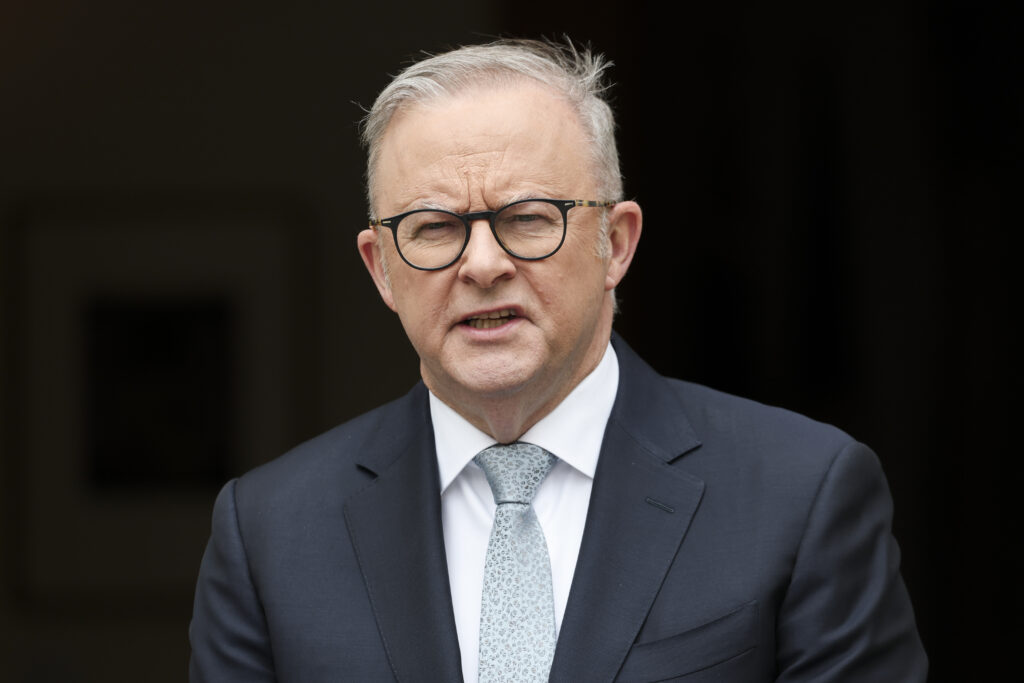
Australian Prime Minister Anthony Albanese meets with President Donald Trump in Washington on Monday, touting his country’s abundant critical minerals as a way to loosen China’s grip over global supplies.At the same time, Albanese is hoping to secure Trump’s backing for a 2021 pact to arm Australia with silent, nuclear-powered attack submarines.Australians have a mostly …
Aussie PM meets Trump with critical minerals on offer Read More »