
AFP Asia Business
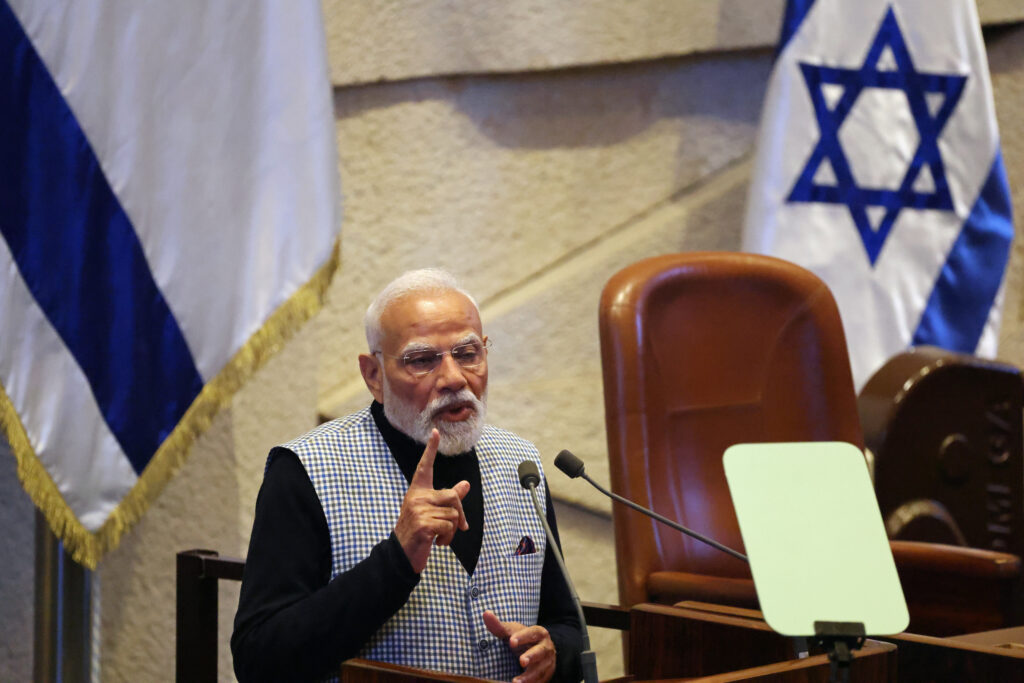
Modi says India stands ‘firmly’ with Israel during visit
Prime Minister Narendra Modi told lawmakers in Jerusalem on Wednesday that India stands “firmly” with Israel following Hamas’s attack on October 7, 2023.Modi also met with Israeli Prime Minister Benjamin Netanyahu during a two-day visit aimed at deepening trade and defence ties that has drawn criticism at home.”I… carry with me the deepest condolences of the people of India for every life lost and for every family whose world was shattered in the barbaric terrorist attack by Hamas on October 7,” Modi said in the Knesset, the Israeli parliament.”We feel your pain, we share your grief. India stands with Israel firmly with full conviction in this moment and beyond.”In his speech, Modi did not explicitly mention the tens of thousands of Palestinians killed in Gaza during the more than two-year war between Israel and Hamas.But he said that India “supports all efforts that contribute to durable peace and regional stability”.Modi also told Israeli lawmakers that his country’s economic growth and Israel’s leadership in technological innovation formed a “natural foundation for our forward-looking partnership”.”I see a lot of synergies in areas such as quantum technologies, semiconductors and artificial intelligence,” he added.Netanyahu told Modi that “India supports Israel because it understands that Israel serves as a defensive wall against barbarism”, adding that his visit will allow them to “further reinforce our ties”. It is Modi’s second visit to Israel as prime minister since he took office in 2014.- ‘A real friendship’ -Earlier on Wednesday, a red carpet was rolled out at Israel’s Ben Gurion airport and Modi was greeted with a hug by Netanyahu as he disembarked the plane.”The two leaders share a special and a personal relationship,” Shosh Bedrosian, spokeswoman for Netanyahu’s office, said in a video posted on X.”The bond between Israel and India is a powerful alliance as we are partners in innovation, security and a shared strategic vision,” she added.Netanyahu’s office said the two right-wing leaders held a private meeting after the welcoming ceremony, with the Israeli premier hailing “a real friendship”.In a post on X, Modi described the meeting as “excellent”.”We discussed a wide range of topics aimed at deepening and strengthening the bilateral relations between our two countries,” he said.The pair “held an in-depth conversation about major developments in the region”, he added.Modi is also scheduled to meet Israeli President Isaac Herzog during the visit.New Delhi has steadily expanded cooperation with Israel across the defence, agriculture, technology and cybersecurity sectors, while balancing diplomatic interests in the Middle East.Talks opened in New Delhi on Monday for an India-Israel Free Trade Agreement (FTA), India’s government said in a statement, noting that merchandise trade reached $3.62 billion in 2024-2025.Full diplomatic relations between the two countries were established in 1992. Ties deepened after Hindu-nationalist leader Modi took office in 2014.- Criticism at home -Modi first visited Israel as prime minister in 2017, before Netanyahu made a reciprocal visit to India the following year.In 2023, grand plans were unveiled in New Delhi for an India–Middle East–Europe Economic Corridor — to link railways, ports, electricity, data networks and pipelines, including through Saudi Arabia and Israel.Those plans were stalled by Hamas’s October 7 attack on Israel, which responded with a devastating war in the Gaza Strip.Months after his 2017 visit to Israel, Modi travelled to Ramallah, seat of the Palestinian Authority.His current visit has sparked criticism at home.Senior Congress party figure Priyanka Gandhi — sister of opposition leader Rahul — posted on social media on Wednesday that she hoped Modi would mention the killing of “thousands of innocent men, women and children in Gaza” during his address to the Israeli parliament.India, the world’s most populous nation with 1.4 billion people, is majority Hindu, but an estimated 220 million Indians are Muslim.One of India’s largest conglomerates, Adani Group, operates the Israeli port of Haifa, while Israeli military drone technology played a pivotal role during India’s May 2025 clash with Pakistan.
Iran negotiators arrive in Geneva for high-stakes US talks
An Iranian delegation headed by its top diplomat arrived in Geneva on Wednesday for talks with the US, as the Islamic republic’s president struck an upbeat tone about the prospect of a negotiated agreement to avert fresh conflict.Donald Trump has repeatedly threatened strikes if Iran fails to cut a deal on its atomic programme, and in his State of the Union address on Tuesday, the US president accused Tehran of “sinister nuclear ambitions” after he ordered a massive military deployment around the Gulf.Piling on the pressure, the US announced fresh sanctions targeting Iran on Wednesday as Vice President JD Vance warned Tehran to take Washington’s threats of military action “seriously”.But Iranian President Masoud Pezeshkian said that he had a “favourable outlook for the negotiations”.”We are continuing the process under the guidance of the supreme leader so that we can move beyond this ‘neither war nor peace’ situation,” Pezeshkian said in a speech.Iranian Foreign Minister Abbas Araghchi and his negotiating team arrived in the Swiss city of Geneva on Wednesday for the crunch talks to be held the following day, Iran’s government said.Araghchi “met and held talks with Omani Foreign Minister Badr Albusaidi”, Iranian news agency Mehr said on Telegram. Iran’s foreign ministry said in a statement earlier that the delegation would meet with Albusaidi “to present Iran’s position on the lifting of sanctions and the nuclear issue”.Trump in his address said that Iran was “at this moment again pursuing their sinister nuclear ambitions”.But Iranian foreign ministry spokesman Esmaeil Baqaei refuted those claims as “simply the repetition of ‘big lies'”.- ‘Maximum pressure’ -The West believes Iran is seeking an atomic bomb, but Tehran insists its nuclear programme is peaceful.”My preference is to solve this problem through diplomacy but one thing is certain: I will never allow the world’s number one sponsor of terror, which they are by far, to have a nuclear weapon,” Trump said.Vance said Trump has “a number of other tools at his disposal to ensure” that Iran does not develop nuclear weapons.”He’s shown a willingness to use them and I hope the Iranians take it seriously in the negotiations tomorrow,” the vice-president told Fox News.The US Treasury Department also announced new sanctions targeting more than 30 individuals, entities and vessels said to be enabling “illicit Iranian petroleum sales” and weapons production.Treasury Secretary Scott Bessent said the Trump administration will continue to push for “maximum pressure on Iran to target the regime’s weapons capabilities and support for terrorism”.Iran and the US held five rounds of nuclear talks last year, but those negotiations ended after Israel’s unprecedented attack on Iran triggered a 12-day war that Washington briefly joined.During his first term, Trump withdrew from a landmark 2015 deal which offered Tehran sanctions relief in return for drastic curbs on Iran’s nuclear programme.- ‘People are suffering’ -In recent weeks Trump has deployed two aircraft carrier groups and dozens of other warplanes to the region to back up his threats, and Iran has repeatedly said it would respond firmly to any attack, even a limited one.Tehran residents who spoke to AFP on Wednesday were divided as to whether there would be renewed conflict.Some said war was all but inevitable, while one salesman who gave his name as Mehdi predicted the negotiations would succeed, saying: “The Americans are bluffing.”Homemaker Tayebeh noted that Trump had “said that war would be very bad for Iran”.”There would be famine and people would suffer a lot. People are suffering now, but at least with war, our fate might be clear,” she added.Emile Hokayem, senior fellow for Middle East security at the International Institute for Strategic Studies, said the huge military outlay carried a political cost for Trump.”It looks like President Trump has cornered himself,” Hokayem said, adding the US leader may have predicted the “Iranians would cave quickly”, which they have yet to do.”At this point, the force posture is such that if the US were to pull back without (an agreement), it could come at the credibility of the president himself.”