
AFP Asia Business
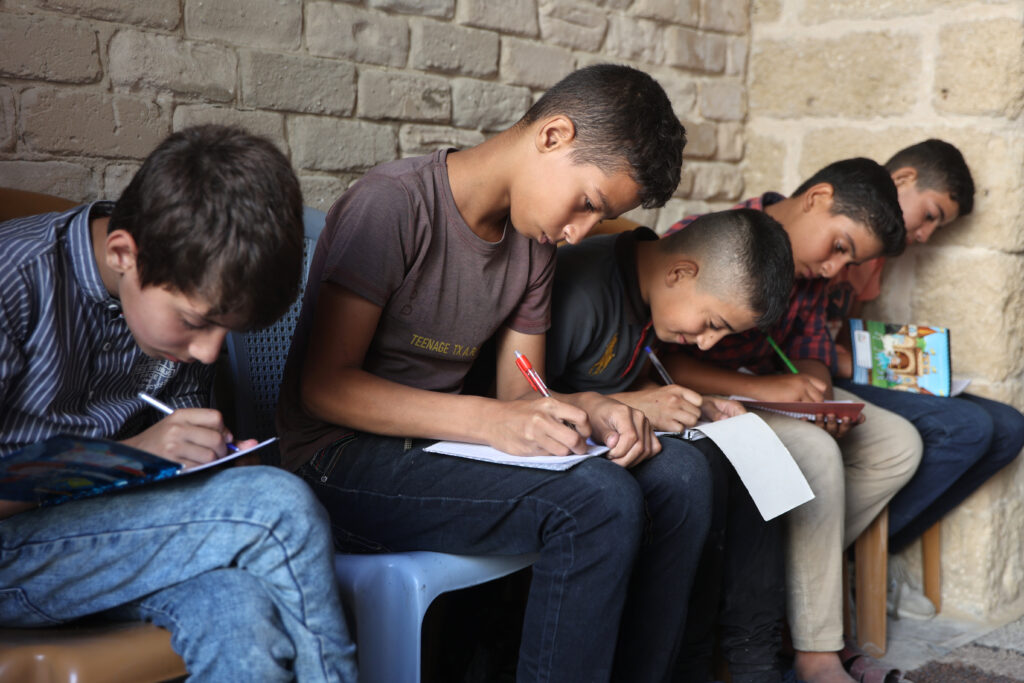
Schools but no books: Gaza’s children return to makeshift classrooms
With no backpack, books or uniform, 11-year-old Layan Haji navigates the ruins of Gaza City and heads to a makeshift classroom after two years of war halted her education.But the school is not what she is used to. Painted walls and students’ artwork no longer adorn the walls and hallways — instead, tents set up in a battered building serve as their temporary classrooms. “I walk for half an hour at least. The streets are devastated, full of ruins… It is difficult and sad,” Haji said, wearing a torn shirt and patched trousers.But “I am happy to return to my studies,” added the young girl, who already dreams of becoming a doctor.Haji is one of 900 students who are going to the Al-Louloua al-Qatami school, one of a number of these establishments that have opened their doors in a bid to allow children to resume their schooling for the first time since the Israel-Hamas war broke out.”We don’t have books or notebooks. The libraries are bombed and destroyed,” said Haji, who lives in a displacement camp in the Tal al-Hawa area in Gaza City.”There is nothing left,” she added.A month after a fragile ceasefire took effect, the UN agency for Palestinian refugees (UNRWA) and Gaza’s education ministry announced that children had gradually begun returning to schools in areas not under Israeli military control.- ‘Heavy labour’ -Sixteen-year-old Said Sheldan said he was full of joy at being able to attend school now that the war has stopped.But “I don’t have books, notebooks, pens or a bag. There are no chairs, electricity or water — not even streets,” he said. But before going to the classroom, Sheldan has much more basic needs to attend to.”Every morning, I have to collect water and wait in line for bread,” said Sheldan, whose family has been displaced “10 times” and “no longer have a home”.Headmaster Iman al-Hinawi, 50, said the school hopes to provide books and other supplies soon and for free.But she warned that the war has forced Gaza’s children to perform “heavy labour” to support their families, especially in cases where the breadwinner has been killed.”They collect firewood, fetch water and stand in line for food” across the territory where the UN previously declared famine.AFP correspondents have witnessed scenes where countless children, clutching plastic buckets, dented pans or even just plates, cry and shout as they jostle through massive crowds to collect food for their families.In an effort to address the psychological distress the children have endured, Hinawi said the school has adopted new learning methods through playing.Young girls compete by dancing to solve math equations and other children act out comedic scenes to recite poems on the curriculum.But Faisal al-Qasas, in charge of the Al-Louloua al-Qatami school, said the children are constantly preoccupied by the queues for bread and water.The school, having launched two shifts for 900 children, now uses “extracurricular activities to address the students’ mental health” and help them resume their studies.- A critical moment -According to a UN assessment, 97 percent of Gaza’s schools sustained some level of damage, including from “direct hits”, with most of them needing full reconstruction or major rehabilitation.Israeli strikes have killed many Palestinians sheltering in schools, with Israel alleging that Hamas fighters hide in such establishments.With schools also serving as displacement shelters, UNRWA has recently opened “temporary learning spaces”.Last month, UNRWA chief Philippe Lazzarini said that more than 25,000 children have joined these new spaces, and some 300,000 would follow online classes.But that still falls short of the education ministry’s estimates of more than 758,000 students in the strip.In the Al-Mawasi area in southern Gaza, local initiatives, some of which receive international support, are hoping to bring children back to school.Qatar’s Education Above All Foundation has launched the “Rebuilding Hope for Gaza” programme, aimed at supporting more than 100,000 students.The programme includes distributing school supplies, ensuring access to the internet and electricity, and providing psychological support.But even with that support, one such school in the Al-Mawasi area can only offer four subjects: Arabic, English, maths and science. Hazem Abu Habib, from an initiative backed by the foundation, said “we aim to help as many students as possible resume their education, even if it’s just with basic courses”.Before the war, Gaza was “completely free of illiteracy”, he said.But now “education is facing its most critical period”.

Yemeni drugs seizure a ‘landmark moment’, say WADA
The seizure of a large amount of performance-enhancing drugs in a raid by Yemeni law enforcement agents is “a landmark moment”, the head of investigations for the World Anti-Doping Agency (WADA) has told AFP.Gunter Younger said the operation, which netted 447kg of both narcotics and performance-enhancing substances, mainly amphetamines, showed authorities were increasingly tracking the cross-border trade of prohibited substances.The raid — one of several carried out including at sea — sends “a clear signal to criminal networks that the landscape is shifting, that trafficking of performance-enhancing drugs is now on the radar of the authorities”, Younger said.WADA and the Yemeni authorities believe Syrian and Iranian drugmakers have switched their operations to Yemen since the fall of the Assad regime in Syria in December last year.They believe the drugmakers are exploiting the war and economic crisis in Yemen and claim the drugs provide a source of income for the Iranian-backed Huthi rebel group in the country.Major Murad al-Radwany, Interpol’s Yemen-based internal security coordinator, expressed satisfaction his colleagues had helped to dismantle “the first factory to be set up in Yemen and equipped with the latest modern devices”.”It was controlled and dismantled before it began operations and exporting drugs and stimulants abroad, and the experts were arrested,” he told AFP.”At the same time, they were preparing to open a new factory in other cities” to “export drugs and stimulants to neighbouring countries”, he said.Al-Radwany said both Syrian and Iranian “experts” had been arrested.”We are concerned about the spread of such factories in Yemen and the exploitation of the situation our country is going through, whether economic conditions or due to wars,” he said.”Iran is the one that provided the experts with financial support and modern equipment, and investigations have proven this, as well as the experts’ confessions.”Al-Radwany, who did not participate directly in the raids but monitored intelligence and coordinated with the security agencies, said: “The Huthis consider it a source of income, facilitating smuggling to neighbouring countries.”Iran also benefits from this, and its goal is to export drugs and stimulants to Arab countries and destabilise security and stability in Yemen and neighbouring countries.”An Iranian foreign ministry official said the claims were “unfounded”.”This is simply absurd and we firmly reject it,” the official told AFP. “Iran’s sacrifices in countering organised crime and drug-trafficking are world renowned and clear to all.”- ‘Swing the pendulum’ -The raid followed a workshop in Saudi Arabia which was part of WADA’s Global Anti-Doping Intelligence and Investigation Network, or GAIIN for short.Younger said GAIIN had “helped reframe doping as not just a problem for sports, but a wider societal issue”.He said the trade in performance-enhancing drugs had “now drawn the attention of transnational crime groups”.”These gangs are using established criminal mechanisms to take advantage of the profitability of these products.”Younger, a former head of the Bavarian state police cybercrime division, said police forces globally were allocating more resources to the problem.”This is a huge win for the protection of clean sport and ultimately for public health,” he said.Al-Radwany called for more international bodies to support the fight, but he maintained that despite the risks, his agents would pursue the drug smugglers.”We and our families face danger from these gangs and smugglers, yet we continue to pursue them.”Younger is unstinting in his praise of the courage of Al-Radwany and his team.”They are not just removing these potentially dangerous substances from circulation, they are also confronting threats to their own safety at the hands of ruthless criminal gangs,” he said.”Every bust, each network or lab dismantled, each seizure made and each criminal convicted helps to swing the pendulum back in our favour.”