
AFP Asia Business

Iran detains Nobel-prize winner in ‘brutal’ arrest
Iranian security forces on Friday detained the 2023 Nobel Peace Prize winner Narges Mohammadi along with at least eight other activists in an arrest condemned as “brutal” by the Norwegian Nobel committee.Mohammadi, who was granted temporary leave from prison in December 2024, was detained along with eight other activists at the ceremony for lawyer Khosrow Alikordi, who was found dead in his office last week, her foundation wrote on X.Those arrested at the ceremony in the eastern city of Mashhad included Mohammadi’s fellow prominent activist Sepideh Gholian, who had previously been jailed alongside her in Tehran’s Evin prison.”These individuals were present solely to pay their respects and express solidarity at a memorial ceremony,” her foundation said, adding the arrests “constitute a blatant and serious violation of fundamental freedoms and basic human rights”.”Narges was beaten on the legs and she was held by her hair and dragged down,” one of her brothers, Hamid Mohammadi, told AFP in Oslo where he lives.The Norwegian Nobel Committee said it was “deeply concerned by today’s brutal arrest” of Mohammadi, calling on Iran to “immediately” clarify her whereabouts.The arrest came two days after the ceremony in Oslo for the 2025 prize winner, Venezuelan opposition leader Maria Corina Machado, a fierce critic of Venezuelan President Nicolas Maduro who is an ally of Tehran. The Nobel committee said it “notes” the timing “given the close collaboration between the regimes in Iran and Venezuela”.Within Iran, the Mehr news agency cited the Mashhad governor Hassan Hosseini as saying the individuals were arrested at the ceremony after “chanting slogans deemed contrary to public norms” but did not name them.- Slogans at funeral -Alikordi, 45, was a lawyer who had defended clients in sensitive cases, including people arrested in a crackdown on nationwide protests that erupted in 2022.His body was found on December 5, with rights groups calling for an investigation into his death, which Norway-based NGO Iran Human Rights said “had very serious suspicion of a state murder”.The US-based Human Rights Activists News Agency (HRANA) posted footage of Mohammadi, who was not wearing the headscarf women are obliged to wear in public in the Islamic republic, attending the ceremony with a crowd of other supporters of Alikordi.It said they shouted slogans including “Long live Iran,” “We fight, we die, we accept no humiliation” and “Death to the dictator” at the ceremony which, in line with Islamic tradition, marked seven days since Alikordi’s death.Other footage broadcast by Persian-language television channels based outside Iran showed Mohammadi climbing on top of a vehicle with a microphone and encouraging people to chant slogans.”When peaceful citizens cannot mourn without being beaten and dragged away, it reveals a government terrified of truth and accountability. It also reveals the extraordinary bravery of Iranians who refuse to surrender their dignity,” said Hadi Ghaemi, executive director of the New York-based Center for Human Rights in Iran.- Years behind bars -Mohammadi, 53, who was last arrested in November 2021, has spent much of the past decade behind bars. Her two twin children received the Nobel prize in Oslo on her behalf in 2023, and she has now not seen them for 11 years. Her temporary release in December 2024 was allowed on health grounds after problems related to her lungs and other issues.”In the prison, she had lots of complications. Her lungs, her heart, she has had some operations,” said Hamid Mohammadi. “I’m not worried that she is arrested. She’s been arrested a lot of times, but what worries me most is that they will put a lot of pressure on her physical and psychological condition. And it might lead to again experiencing those complications,” he added.Mohammadi has also regularly predicted the downfall of the clerical system that has ruled Iran since the 1979 Islamic revolution, saying in a 19th birthday message to her twins last month that “they (the authorities) themselves live each day in fear of the fall that will inevitably come at the hands of the people of Iran”.
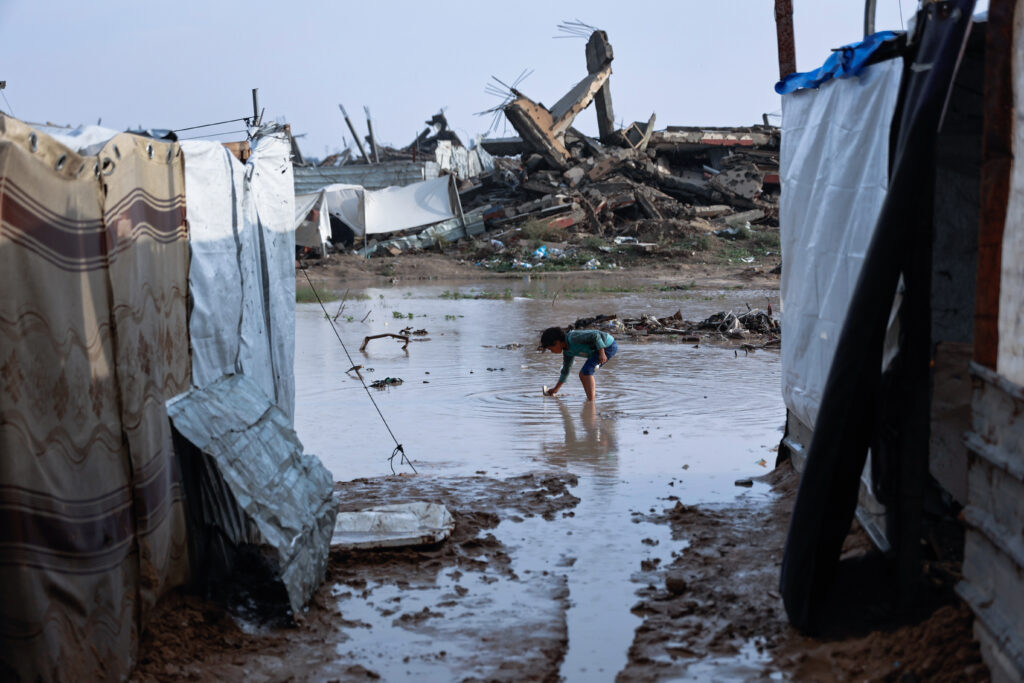
Gaza civil defence says 16 dead as heavy rains batter territory
Gaza’s civil defence agency on Friday said at least 16 people had died in the last 24 hours, including three children who died from exposure to the cold, as a winter storm batters the territory.Heavy rain from Storm Byron has flooded tents and temporary shelters across the Gaza Strip since late Wednesday, compounding the suffering of the territory’s residents, nearly all of whom were displaced during more than two years of war.Gaza’s civil defence agency, which operates as a rescue force under Hamas authority, told AFP three children had died from exposure to the cold — two in Gaza City and one in Khan Yunis in the south.Al-Shifa Hospital in Gaza City confirmed the deaths of Hadeel al-Masri, aged nine, and Taim al-Khawaja, who it said was just several months old.Nasser Hospital in Khan Yunis on Thursday said eight-month-old Rahaf Abu Jazar had died in the nearby tented encampment of Al-Mawasi due to the cold.With most of Gaza’s buildings destroyed or damaged, thousands of tents and makeshift shelters now line areas cleared of rubble.Civil defence spokesman Mahmud Bassal said six people died when a house collapsed in the Bir al-Naja area of the northern Gaza Strip.Two bodies were recovered from the rubble of a home in the Sheikh Radwan neighbourhood of Gaza City, he added.Five others died when walls collapsed in multiple separate incidents, Bassal said.In a statement, the civil defence said its teams had responded to calls from “13 houses that collapsed due to heavy rains and strong winds, mostly in Gaza City and the north”.- No dry clothes -Under gloomy skies in Nuseirat in the central Gaza Strip, Palestinians used bowls, buckets and hoes to try and remove the water that had pooled around their tents made of plastic sheeting.Young children, some barefoot and others wearing open sandals, trudged and hopped through ponds of muddy water as the rain continued to fall.”The mattress has been soaked since this morning, and the children slept in wet bedding last night,” Umm Muhammad Joudah told AFP.”We don’t have any dry clothes to change into.”Saif Ayman, a 17-year-old who was on crutches due to a leg injury, said his tent had also been submerged.”In this tent we have no blankets. There are six of us sleeping on one mattress, and we cover ourselves with our clothes,” he said.Jonathan Crickx, spokesman for the UN children’s agency who is currently in Gaza, told AFP night-time temperatures could drop to around eight or nine degrees Celsius (46-48 degrees Fahrenheit).”The rains are heavy, and these families are living in makeshift tents battered by the wind, where they’re barely protected by a plastic tarp,” he said.Samer Morsi, a 22-year-old displaced Palestinian sheltering in the central area of Deir el-Balah, said he had “spent the night holding onto the tent pole so it wouldn’t fly away in the strong wind”.”We don’t know how to cope with these harsh conditions,” he added.”We are human beings with feelings, not made of stone.”- ‘Appalling hygiene conditions’ -Crickx also described “absolutely appalling hygiene and sanitary conditions,” saying there was a fear that preventable waterborne illnesses could spread.”There aren’t enough toilets, there are places — I saw some in Gaza City — where large pools of water are essentially open sewers right next to the displacement camps. So we’re especially concerned for the immediate health of the children,” he said.A ceasefire between Israel and militant group Hamas that took effect in October has partially eased restrictions on goods and aid entering into the Gaza Strip.But supplies have entered in insufficient quantities, according to the United Nations, and the humanitarian needs are still immense.The UN’s World Health Organization warned on Friday that thousands of families were “sheltering in low-lying or debris-filled coastal areas with no drainage or protective barriers”.”Winter conditions, combined with poor water and sanitation, are expected to drive a surge in acute respiratory infections,” it added.