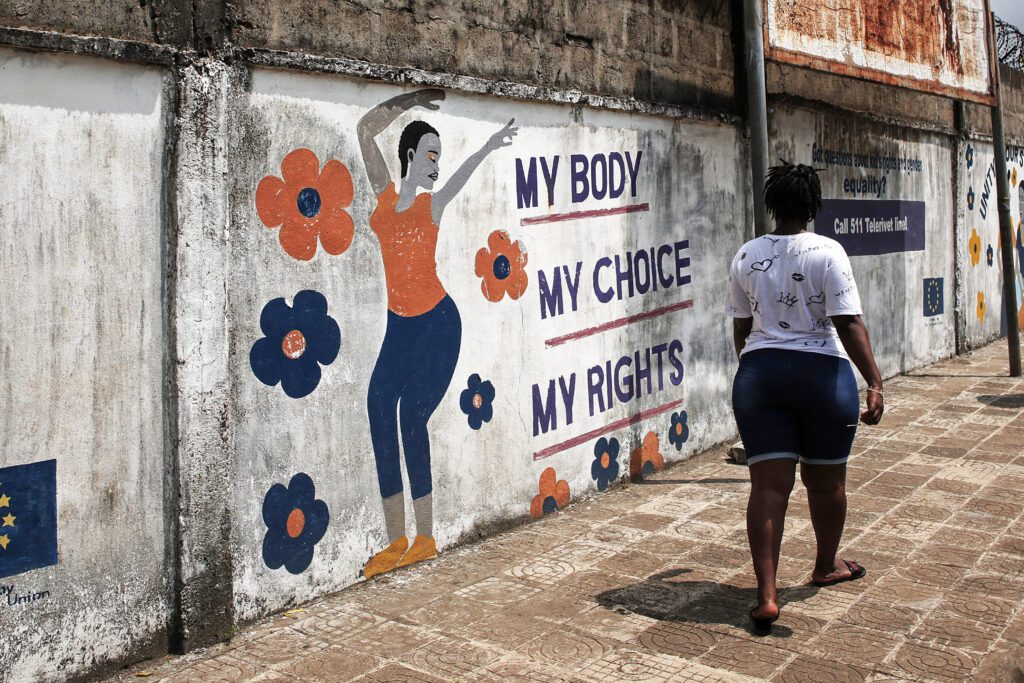
Lacking support and feeling terrified, Mary turned to one of Sierra Leone’s traditional healers when she found out she was pregnant as a teenager, an ordeal that left her with permanent pain and emotional scars.Leaning against a veranda railing in an overcrowded slum on the outskirts of Freetown, she clasped her hands tightly as if holding herself together as she told AFP of the traumatic experience with the healer and their tinctures.In Sierra Leone, where abortion is illegal unless a mother’s life is at risk, women often go to drastic and dangerous lengths to terminate a pregnancy.Abortion advocates were buoyed by a bill introduced in parliament last year and favoured by President Julius Maada Bio which would have decriminalized abortion.But the measure has stalled with little sign of revival as many point to staunch opposition from Sierra Leone’s religious Christian and Muslim communities as the cause.”Traditional healers perform the most dangerous procedures,” Tamba Kongoneh, surgical health officer at the Planned Parenthood Association of Sierra Leone, told AFP, explaining how some insert “cassava sticks and other objects into the vagina to abort pregnancies, which usually perforate the womb or the intestines”. Mary, whose name has been changed to protect her identity, told AFP how she became pregnant in her mid-teens after her boyfriend convinced her to have sex.”I went to an old woman, a traditional healer, to abort the pregnancy due to the shame and stigma,” she said, explaining how she drank a tea of boiled paw-paw leaves and herbs.The mixture’s side effects left her “in pain for the rest of the night” and fearing for her life, with severe stomach cramps and profuse bleeding that lasted for weeks.Now age 28 she still lives with “painful menstrual cycle complications — I bleed for two weeks with severe pain every month”.- ‘In conflict’ – Approximately 91,500 illegal abortions were carried out in Sierra Leone in 2021, according to a report by the African Population and Health Research Center (APHRC) published in 2024.About a decade after Sierra Leone failed to pass a pro-abortion law in 2015, President Bio engaged with stakeholders in January, encouraging parliament to move forward on his Safe Motherhood and Reproductive Health Bill. “We cannot do the transformative changes that are required if we are timid,” he said at the time.Since then, he and parliament have gone silent.The give and take between public health and deeply rooted religious and cultural beliefs is often fraught in Sierra Leone, as in the larger west Africa region.The “sexual and reproductive health services” mentioned throughout the bill “is synonymous to abortion”, Edward Tamba Charles, the Catholic archbishop of Freetown, told AFP.Charles is also the head of the Inter-Religious Council of Sierra Leone, a civil society organisation of Christians and Muslims that promotes peaceful religious co-existence, which has come out strong against the bill.”The bill is in conflict with our religious, ethical and societal values and it will be endangering women and society,” Charles said.In addition to religious backlash, US cuts to foreign aid, including for contraception and family planning, is affecting supplies intended for low-income countries like Sierra Leone.- ‘Didn’t know anything’ -Fatu Esther Jusu was just 15 years old when she aborted a pregnancy by mixing traditional medicine and antibiotics recommended by friends, later developing complications and profuse bleeding for days.”I didn’t know anything about pregnancy, it was a horrible experience, I was scared,” Jusu, who said she feared for her life, told AFP.”Experience is the best teacher, I don’t want what happened to me to happen to any other girl or woman in our society,” Jusu said.Now age 22 and working as a nurse and community advocate, Jusu was crowned by the United Nations Fund for Population (UNFPA) as Sierra Leone “Miss Condom” 2025 for her work promoting abstinence and contraceptives.A 2025 Afrobarometer round of surveys indicated that 82 percent of Sierra Leoneans support contraceptive access, yet 87 percent reject abortion for unwanted pregnancy.Kongoneh of Planned Parenthood told AFP that he has “performed many surgical operations as a result of abortion complications in young girls and women”.Following unofficial and dangerous procedures that result in complications, the women become “afraid they might die because they trusted the wrong person or because they had no other option”, he said.”I treat their infections, stop their bleeding, and do everything I can to save them,” Kongoneh added.