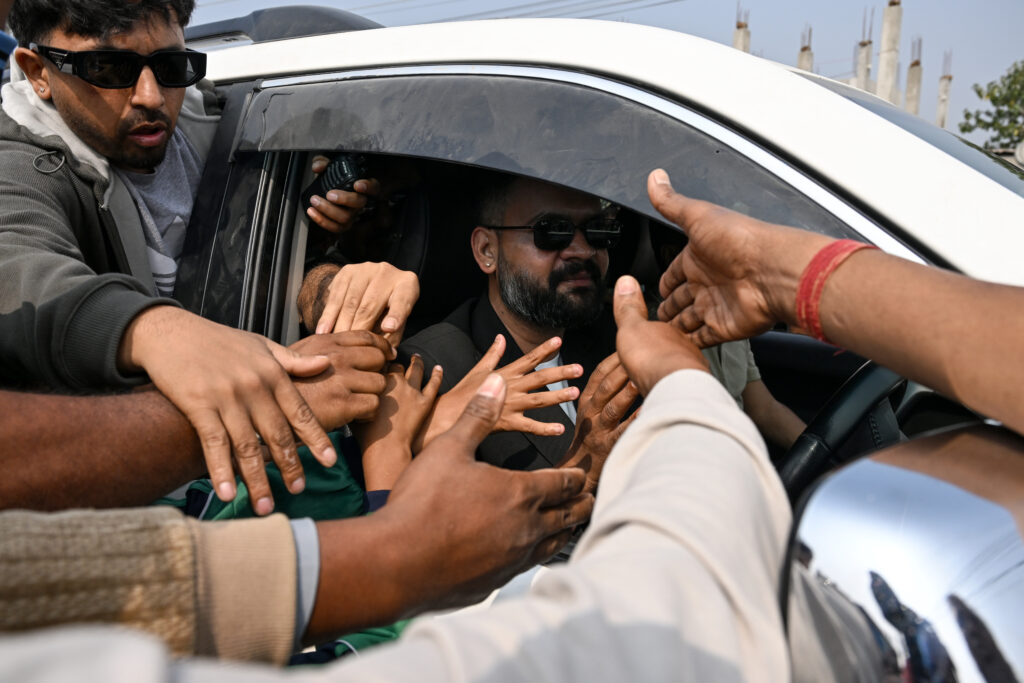
Nepal’s election campaign entered its final day on Monday, six months after deadly anti-corruption protests toppled the government, with rival leaders making a last push in a tightly contested race.The Himalayan republic will elect a new parliament on Thursday, replacing the interim government that has led the country of 30 million people since the September 2025 uprising in which at least 77 people were killed.Sushila Karki, who is serving as prime minister until the vote, called for “peace and harmony” in a broadcast to the nation on Monday.Karki, a former chief justice, also urged all to vote to “move the country forward on the path of political stability and prosperity”.”It is only with your active participation that our democracy will survive,” she added.Two weeks of campaigning have showcased a wave of younger candidates promising to tackle Nepal’s woeful economy, challenging veteran politicians who have dominated for two decades and argue that their experience guarantees stability and security.Among the key figures is KP Sharma Oli, the 74-year-old Marxist leader ousted as prime minister last year.”Other candidates are all new, they have no experience, nothing,” Oli told reporters as he campaigned on Monday.But he faces a high-profile challenge in his home constituency from former Kathmandu mayor Balendra Shah, a 35-year-old rapper-turned-politician widely known as Balen.Their constituency of Jhapa-5 — a mix of towns and farming settlements in Nepal’s eastern plains, with the world’s highest peaks on the horizon — has emerged as a crucial battleground.A local defeat for either man would likely end his bid to become prime minister.- ‘Old age’ club -“We have had a difficult few years with old leadership, and we need new energy,” 50-year-old bus driver Pawan Jha told AFP, as he attended Shah’s rally in Jhapa. “The protests were important to bring about change.”Shah, dressed in a sharp-cut black suit and sunglasses, waving from a car he was driving himself through farmlands of Jhapa, arrived at his rally to cheers, whistles and thumping music.Oli, speaking to AFP, blamed “anarchic forces” for the violence that led to his removal and denied ordering security forces to kill protesters during the unrest.Shah, from the centrist Rastriya Swatantra Party (RSP), has cast himself as a symbol of youth-driven political change.”Gen Z’s number one demand is good governance, because there is a high level of corruption in the country,” Shah told AFP.But he is not the only one wooing the youth vote.Aspiring prime minister Gagan Thapa, 49, the new head of the country’s oldest party, Nepali Congress, told AFP he wanted to end the “old age” club of revolving veteran leaders.Thapa, a former health minister who took charge in January, said he offers voters the “right mix of energy and experience”.The last day of campaigning coincides with Holi, the Hindu festival of colours, with some candidates combining celebrations with their rallies.- ‘Without any fear’ -Nearly 19 million registered voters will elect 275 members of the House of Representatives, the lower chamber of parliament — 165 directly, with a further 110 chosen via a party-list proportional representation.Analysts say the vote is unlikely to deliver an outright majority for any single party.The youth-led protests in September were triggered by a brief social media ban, but were fuelled by anger at economic stagnation and an ageing elite seen as out of touch.The World Bank estimates 82 percent of Nepal’s workforce is in informal employment, with GDP per capita at $1,447 in 2024.Millions are forced to seek work abroad — and their remittances make up the equivalent of around a third of Nepal’s GDP.”Unemployment is a big issue, that needs to be resolved,” said shopkeeper Mamata Devi Goswami, 49, who said she would vote for change.”The youth should work here and earn their living, rather than go out of the country.”Over two days in September, 77 people were killed, scores were injured, and hundreds of buildings were set on fire — including parliament, courts and a Hilton hotel.It was the country’s worst violence since a decade-long civil war ended in 2006.