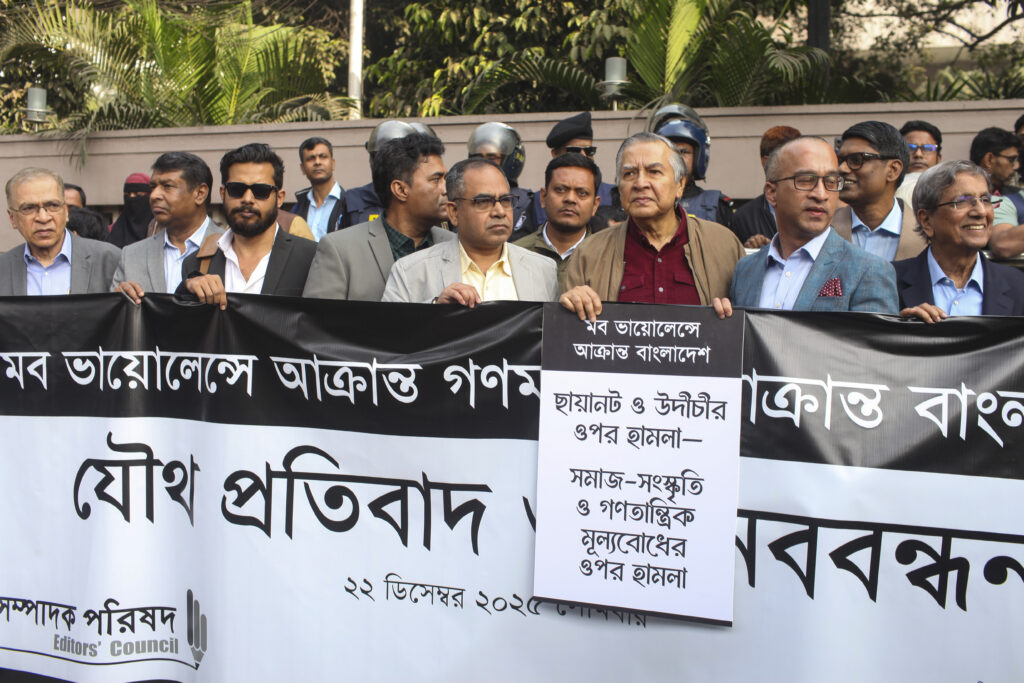
Bangladeshi journalists protested on Monday against arson and vandalism at the offices of two leading newspapers, attacked last week as anger over a student leader’s death spilled into violence.Dozens of journalists and media workers formed a human chain in the capital Dhaka, holding placards condemning attacks on “freedom of the press” and on “democratic values”, as security personnel stood guard.On Thursday, angry mobs attacked the offices of Prothom Alo and the Daily Star, torching parts of the buildings and vandalising the premises of the two publications caught up in surging anti-India sentiment in the wake of popular student leader Sharif Osman Hadi’s death.A staunch India critic, 32-year-old Hadi was a key figure in last year’s pro-democracy uprising that ousted former prime minister Sheikh Hasina.He was shot by masked gunmen earlier this month as he was leaving a mosque in Dhaka and succumbed to his injuries on Thursday at a hospital in Singapore.Protesters, roused by his killing, set fire to several buildings including the offices of the two newspapers deemed to favour India, where Hasina, 78, has taken refuge since fleeing the uprising.Nurul Kabir, editor of New Age daily and president of the national Editors’ Council, said the attackers had tried to burn journalists alive.”They set the buildings on fire while journalists were working inside and prevented the fire service from launching rescue operations,” he said at Monday’s rally.”They made their stance clear — that they would burn dissenters alive.”Kabir, who tried to help journalists trapped on a rooftop, said he was assaulted during the rescue attempt.Dhaka Metropolitan Police said 17 people had been arrested in connection with the attacks on the dailies.- ‘Murder threats’ -Senior police officer S.N. Nazrul Islam defended the force’s response.”There was no loss of life, and I consider that a success,” he said.The violence has drawn sharp criticism from rights groups and media houses, who accused the government led by Nobel Peace Prize laureate Muhammad Yunus of failing to prevent the unrest.Anti-India sentiment has been fuelled in part by unconfirmed reports that Hadi’s killers were hiding there.Demonstrators last week also pelted the Indian High Commission in Chattogram with stones and vandalised cultural institutions.Mahfuz Anam, editor and publisher of the Daily Star, said press intimidation had escalated to dangerous levels.”On social media we have seen messages saying journalists of the Daily Star and Prothom Alo should be hunted down and killed in their homes,” he said. “This is no longer about opinions. These are murder threats.”Members of civil society groups and political parties joined the journalists’ protest.”This is not just a time to express solidarity and unity, we must stop and resist this destructive force,” Mirza Fakhrul Islam Alamgir, secretary-general of the Bangladesh Nationalist Party, told reporters.Bangladesh, a South Asian nation of 170 million people, has been in turmoil as it gears up for general elections in February, the country’s first since the fall of Hasina’s autocratic government.
Bangladeshi journalists protested on Monday against arson and vandalism at the offices of two leading newspapers, attacked last week as anger over a student leader’s death spilled into violence.Dozens of journalists and media workers formed a human chain in the capital Dhaka, holding placards condemning attacks on “freedom of the press” and on “democratic values”, as security personnel stood guard.On Thursday, angry mobs attacked the offices of Prothom Alo and the Daily Star, torching parts of the buildings and vandalising the premises of the two publications caught up in surging anti-India sentiment in the wake of popular student leader Sharif Osman Hadi’s death.A staunch India critic, 32-year-old Hadi was a key figure in last year’s pro-democracy uprising that ousted former prime minister Sheikh Hasina.He was shot by masked gunmen earlier this month as he was leaving a mosque in Dhaka and succumbed to his injuries on Thursday at a hospital in Singapore.Protesters, roused by his killing, set fire to several buildings including the offices of the two newspapers deemed to favour India, where Hasina, 78, has taken refuge since fleeing the uprising.Nurul Kabir, editor of New Age daily and president of the national Editors’ Council, said the attackers had tried to burn journalists alive.”They set the buildings on fire while journalists were working inside and prevented the fire service from launching rescue operations,” he said at Monday’s rally.”They made their stance clear — that they would burn dissenters alive.”Kabir, who tried to help journalists trapped on a rooftop, said he was assaulted during the rescue attempt.Dhaka Metropolitan Police said 17 people had been arrested in connection with the attacks on the dailies.- ‘Murder threats’ -Senior police officer S.N. Nazrul Islam defended the force’s response.”There was no loss of life, and I consider that a success,” he said.The violence has drawn sharp criticism from rights groups and media houses, who accused the government led by Nobel Peace Prize laureate Muhammad Yunus of failing to prevent the unrest.Anti-India sentiment has been fuelled in part by unconfirmed reports that Hadi’s killers were hiding there.Demonstrators last week also pelted the Indian High Commission in Chattogram with stones and vandalised cultural institutions.Mahfuz Anam, editor and publisher of the Daily Star, said press intimidation had escalated to dangerous levels.”On social media we have seen messages saying journalists of the Daily Star and Prothom Alo should be hunted down and killed in their homes,” he said. “This is no longer about opinions. These are murder threats.”Members of civil society groups and political parties joined the journalists’ protest.”This is not just a time to express solidarity and unity, we must stop and resist this destructive force,” Mirza Fakhrul Islam Alamgir, secretary-general of the Bangladesh Nationalist Party, told reporters.Bangladesh, a South Asian nation of 170 million people, has been in turmoil as it gears up for general elections in February, the country’s first since the fall of Hasina’s autocratic government.