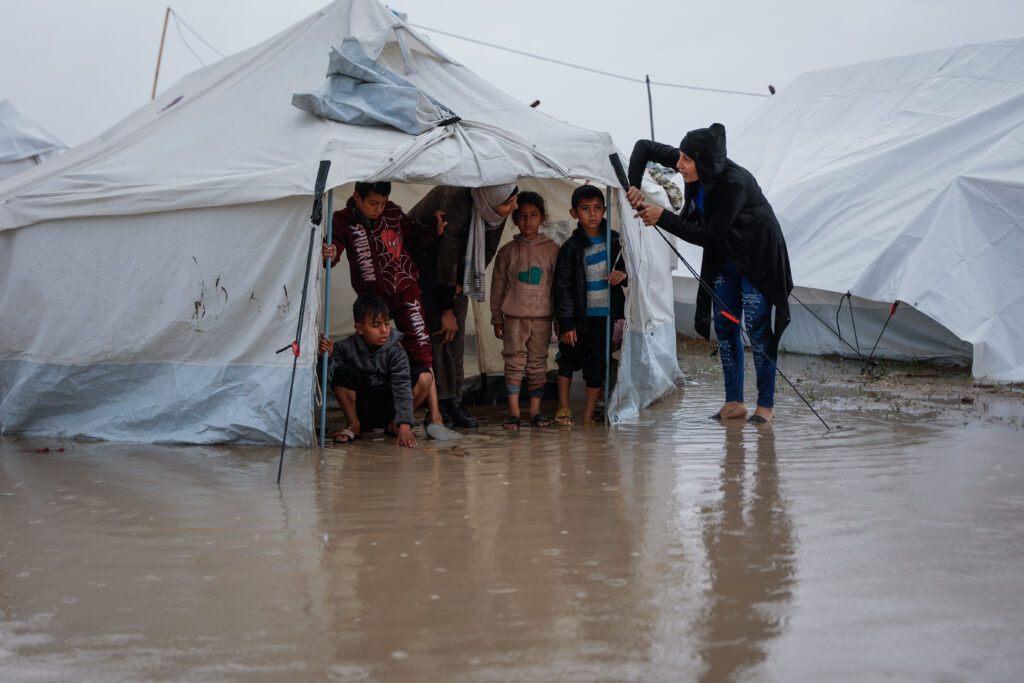
Wearing only sandals and cotton sweaters to protect themselves from the winter rain, Palestinians dug trenches in the muddy ground around their tents in Gaza City’s Zeitoun neighbourhood in an effort to keep out encroaching storm waters. Starting late Wednesday, heavy rains from Storm Byron have swept across the Palestinian territory, flooding tents and makeshift shelters, bringing yet more hardship to Gaza’s residents, nearly all of whom have faced displacement in more than two years of war.In Zeitoun, a child carrying two empty 20-litre jerrycans walked barefoot in the mud to retrieve drinkable water from a temporary water station.With most of Gaza’s buildings destroyed or damaged, thousands of tents and homemade shelters now line areas cleared of rubble.Although a truce between Israel and militant group Hamas that took effect in October has partially eased restrictions on goods and aid, supplies have entered in insufficient quantities, according to the United Nations, and the humanitarian needs are still immense.- ‘Don’t know where to go’ -According to a UN report, 761 displacement sites hosting about 850,000 people are at high risk of flooding.In the low-lying areas between tents in central Gaza’s Al-Zawayda camp, water pooled and formed small ankle-deep ponds, forcing displaced residents to wade through or hop across on exposed patches of soil.”Last night was a terrible night for us and our children because of the heavy rain and cold. The children got all wet, the blankets got wet, the mattresses got wet, and we did not know where to go,” said Suad Muslim, who lives in a tent with her family in Zawayda.”Give us a decent tent, blankets for our children, clothes to wear. I swear their feet are bare and they have no shoes. How long will we remain in this situation? This is injustice,” she told AFP, raising her voice over the sound of large raindrops hitting the plastic tarp roof of her tent.Located between the Sinai and the Negev Desert on one side, and the Mediterranean Sea on the other, the tiny Gaza Strip receives almost all of its precipitation in the form of strong rain in the late autumn and winter.- Drenched with no heat -In the fully closed-off territory, aid shortages mean the already destitute population is not equipped to properly cope with the winter weather.”The situation is dire,” said Shuruq Muslim, a displaced woman from the city of Beit Lahia in northern Gaza. “We can’t even go outside to light a fire (to cook) because we have no gas or firewood.”Gas, firewood, food and medicine have all been in short supply since the start of the war, with most people surviving on aid coming from outside.In Zawayda, the most fortunate had paved the floor of their tents with reused bricks to keep the sodden sand from dampening their few belongings.In areas where tarmac had not been stripped from the road, bulldozers were still at work clearing rubble from buildings destroyed during the war.Many residents in the camp stood under their tent awnings rather than sitting on wet surfaces and waited for the rain to stop.- Reconstruction still far away -Mahmud Bassal, spokesman for Gaza’s civil defence agency, told AFP the weather had brought more suffering for the territory’s already reeling residents, causing one death when a wall collapsed during the storm.”The storm has had a severe impact on the population. Buildings have collapsed and much of the infrastructure has been destroyed, leaving the area unable to drain the large volume of rainfall,” he said.His agency said in a statement Thursday that its teams responded to three houses that partially collapsed during the strong rainfall.It warned residents against returning to homes made structurally unsound during the war — and made even more unsafe by the rains washing away topsoil and rubble.Bassal said more aid needed to enter Gaza, but of the sort that would lead to long-term shelters for people, not temporary fixes.”Tents are categorically rejected. What must be provided now are mobile homes equipped with solar power, comprising two rooms, a bathroom, and all the necessary facilities for residents. Only then can reconstruction begin,” he added.
Wearing only sandals and cotton sweaters to protect themselves from the winter rain, Palestinians dug trenches in the muddy ground around their tents in Gaza City’s Zeitoun neighbourhood in an effort to keep out encroaching storm waters. Starting late Wednesday, heavy rains from Storm Byron have swept across the Palestinian territory, flooding tents and makeshift shelters, bringing yet more hardship to Gaza’s residents, nearly all of whom have faced displacement in more than two years of war.In Zeitoun, a child carrying two empty 20-litre jerrycans walked barefoot in the mud to retrieve drinkable water from a temporary water station.With most of Gaza’s buildings destroyed or damaged, thousands of tents and homemade shelters now line areas cleared of rubble.Although a truce between Israel and militant group Hamas that took effect in October has partially eased restrictions on goods and aid, supplies have entered in insufficient quantities, according to the United Nations, and the humanitarian needs are still immense.- ‘Don’t know where to go’ -According to a UN report, 761 displacement sites hosting about 850,000 people are at high risk of flooding.In the low-lying areas between tents in central Gaza’s Al-Zawayda camp, water pooled and formed small ankle-deep ponds, forcing displaced residents to wade through or hop across on exposed patches of soil.”Last night was a terrible night for us and our children because of the heavy rain and cold. The children got all wet, the blankets got wet, the mattresses got wet, and we did not know where to go,” said Suad Muslim, who lives in a tent with her family in Zawayda.”Give us a decent tent, blankets for our children, clothes to wear. I swear their feet are bare and they have no shoes. How long will we remain in this situation? This is injustice,” she told AFP, raising her voice over the sound of large raindrops hitting the plastic tarp roof of her tent.Located between the Sinai and the Negev Desert on one side, and the Mediterranean Sea on the other, the tiny Gaza Strip receives almost all of its precipitation in the form of strong rain in the late autumn and winter.- Drenched with no heat -In the fully closed-off territory, aid shortages mean the already destitute population is not equipped to properly cope with the winter weather.”The situation is dire,” said Shuruq Muslim, a displaced woman from the city of Beit Lahia in northern Gaza. “We can’t even go outside to light a fire (to cook) because we have no gas or firewood.”Gas, firewood, food and medicine have all been in short supply since the start of the war, with most people surviving on aid coming from outside.In Zawayda, the most fortunate had paved the floor of their tents with reused bricks to keep the sodden sand from dampening their few belongings.In areas where tarmac had not been stripped from the road, bulldozers were still at work clearing rubble from buildings destroyed during the war.Many residents in the camp stood under their tent awnings rather than sitting on wet surfaces and waited for the rain to stop.- Reconstruction still far away -Mahmud Bassal, spokesman for Gaza’s civil defence agency, told AFP the weather had brought more suffering for the territory’s already reeling residents, causing one death when a wall collapsed during the storm.”The storm has had a severe impact on the population. Buildings have collapsed and much of the infrastructure has been destroyed, leaving the area unable to drain the large volume of rainfall,” he said.His agency said in a statement Thursday that its teams responded to three houses that partially collapsed during the strong rainfall.It warned residents against returning to homes made structurally unsound during the war — and made even more unsafe by the rains washing away topsoil and rubble.Bassal said more aid needed to enter Gaza, but of the sort that would lead to long-term shelters for people, not temporary fixes.”Tents are categorically rejected. What must be provided now are mobile homes equipped with solar power, comprising two rooms, a bathroom, and all the necessary facilities for residents. Only then can reconstruction begin,” he added.